
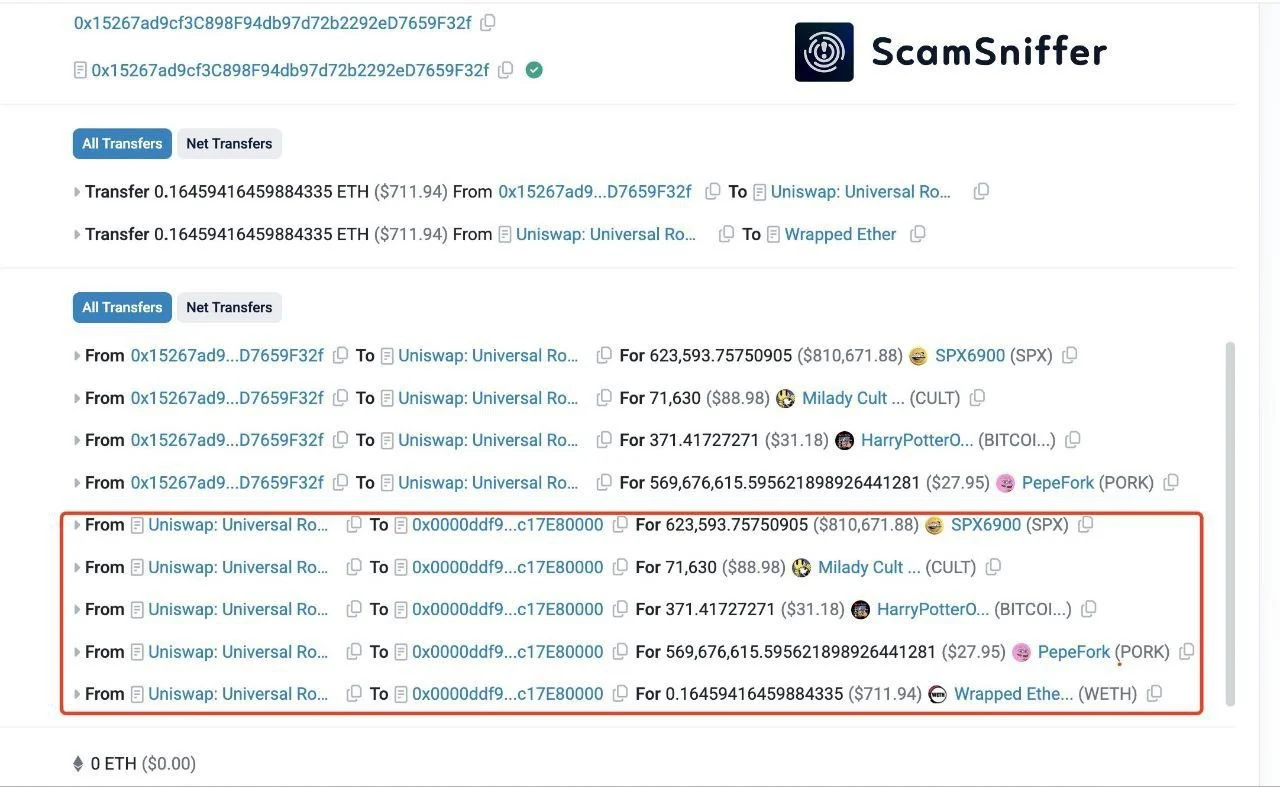
The Phishing Attack Unveiled
The recent phishing scam targeting an investor on the Uniswap platform serves as a stark reminder of the vulnerabilities inherent in decentralized finance (DeFi). The attacker executed a meticulously crafted scheme that began with the creation of a counterfeit website, skillfully designed to resemble the legitimate Uniswap interface. By utilizing deceptive tactics, the fraudster manipulated visual cues and functionalities to gain the trust of unsuspecting users.
Upon navigating to the malicious site, the victim was greeted by what seemed like an authentic Uniswap environment. This false representation lured the victim into a false sense of security, prompting them to initiate token swaps. As the process unfolded, the attacker requested the user to authorize several transactions, persuading them that these actions were necessary for seamless operations. However, unbeknownst to the victim, these requests concealed malicious intentions, empowering the attacker with unauthorized access to the victim’s digital wallet.
This incident highlights a critical distinction between the legitimate token swaps that users expect on decentralized exchanges and the insidious methods employed by phishers. Rather than facilitating genuine transactions, the actions taken by the victim unknowingly permitted the assailant to abscond with valuable assets such as tokens and NFTs. Furthermore, this type of scam underscores the broader trends in the DeFi ecosystem, where attackers often exploit the behavioral patterns and knowledge gaps among users. Most victims may not possess the necessary cybersecurity awareness, making them susceptible to such schemes.
The prevalence of phishing attacks in the DeFi space raises significant concerns for all participants. By continuing to educate users about the mechanics of these scams, it is hoped that individuals can better safeguard their investments against similar threats in the future.
Understanding the Growing Threat of Phishing in DeFi
The decentralized finance (DeFi) landscape has experienced remarkable growth in recent years, attracting a diverse range of investors and users. Unfortunately, this rapid expansion has also seen an alarming increase in phishing attacks. According to statistics from Scamsniffer, phishing scams in the DeFi sector have surged significantly, resulting in millions of dollars in losses. For instance, it was reported that over $16 million was lost to phishing and scam attempts in a recent year alone. Such incidents not only undermine trust in the DeFi ecosystem but also pose a serious risk to users who may not be fully aware of the dangers.
Scammers have become increasingly adept at employing social engineering tactics that exploit human vulnerability rather than relying solely on technical vulnerabilities. This form of manipulation often manifests in emails, messages, or websites that closely mimic legitimate DeFi platforms. Users are lured into providing sensitive information, such as private keys or seed phrases, often without realizing the risks involved. For instance, a well-crafted email can create a sense of urgency, prompting users to act quickly, thereby bypassing their usual caution and leading to devastating consequences.
Additionally, a prominent variant of phishing known as batch transaction phishing has emerged. This sophisticated tactic allows attackers to send fraudulent transaction requests that are easily blended into a user’s legitimate activity. Because these requests often appear alongside legitimate transactions, users may overlook the potentially harmful requests, making them particularly susceptible to falling victim. The continuous evolution of these scams underscores the importance of heightened awareness within the DeFi community. As users navigate this complex landscape, understanding the characteristics and tactics of phishing attacks is crucial for safeguarding their assets.
Strategies for Protecting Against DeFi Phishing Attacks
The rise of decentralized finance (DeFi) has brought numerous opportunities for investors, but it has also created a fertile ground for phishing attacks. To safeguard your digital assets, it is essential to adopt strategic practices that can significantly mitigate the risk of falling victim to these scams. One of the primary steps is to verify URLs before engaging with any DeFi platform. Phishers often create misleading links that closely mimic legitimate sites, making it vital to ensure you are accessing the correct web address. Bookmarking trusted sites can help eliminate this risk.
Moreover, utilizing hardware wallets is highly advisable. These devices store private keys offline and are less susceptible to malicious attacks compared to software wallets connected to the internet. By investing in a reputable hardware wallet, users can enhance their security significantly, reducing the likelihood of unauthorized access to their tokens and NFTs.
Another critical strategy involves carefully reviewing transaction details before signing. Scammers may disguise fraudulent transactions as legitimate requests, so it is essential to scrutinize every detail, including recipient addresses and the amounts involved. Additionally, it is crucial to be cautious of any unsolicited messages or emails requesting sensitive information or prompting urgent actions, as these are common tactics used in phishing schemes.
Obtaining project links from reliable sources can also play a vital role in avoiding scams. Always refer to official channels such as the project’s social media accounts, websites, or community forums to gather information regarding legitimate platforms. This practice not only helps in avoiding phishing links but also keeps investors informed about potential scams in the DeFi landscape.
Lastly, fostering a culture of education and awareness within the DeFi community is paramount in combating phishing attempts. Engaging in discussions, participating in forums, and attending workshops can equip users with the necessary knowledge to recognize and avoid these threats effectively. By implementing these strategies, investors can protect their assets and navigate the DeFi space with greater confidence.
Conclusion: The Importance of Vigilance in the DeFi Ecosystem
The recent incident involving a reported loss of $1 million in tokens and NFTs due to a phishing scam on Uniswap has served as a stark reminder of the vulnerabilities that exist within the decentralized finance (DeFi) ecosystem. While blockchain technology is inherently secure, the human factor often undermines this security, making individual users prime targets for sophisticated scams. This situation underscores the necessity for users to remain vigilant and aware of the potential risks they face.
As the DeFi space continues to grow and attract more participants, it is important to recognize that the landscape is constantly evolving. Scammers are becoming increasingly adept at creating convincing narratives and mechanisms that can deceive even seasoned investors. Therefore, a proactive approach toward education and awareness becomes essential for anyone engaging with DeFi platforms.
Users must commit to continuous learning about best practices for securing their assets, including understanding how to identify phishing attempts, utilizing secure wallets, and ensuring that they are interacting with reputable platforms. The implementation of two-factor authentication and maintaining updated software can also significantly enhance security measures. Furthermore, users should stay informed about the latest developments in DeFi, as new threats often emerge in tandem with innovations.
In light of these considerations, it is evident that while blockchain technology provides a foundation for secure transactions, the responsibility of safeguarding digital assets lies largely with the users themselves. By fostering a culture of vigilance and education, DeFi participants can protect themselves against the increasingly sophisticated tactics employed by scammers. As adoption increases, the onus is on individuals to stay informed and proactive in order to navigate the complex and dynamic DeFi environment safely.