
Understanding the Recent Market Decline
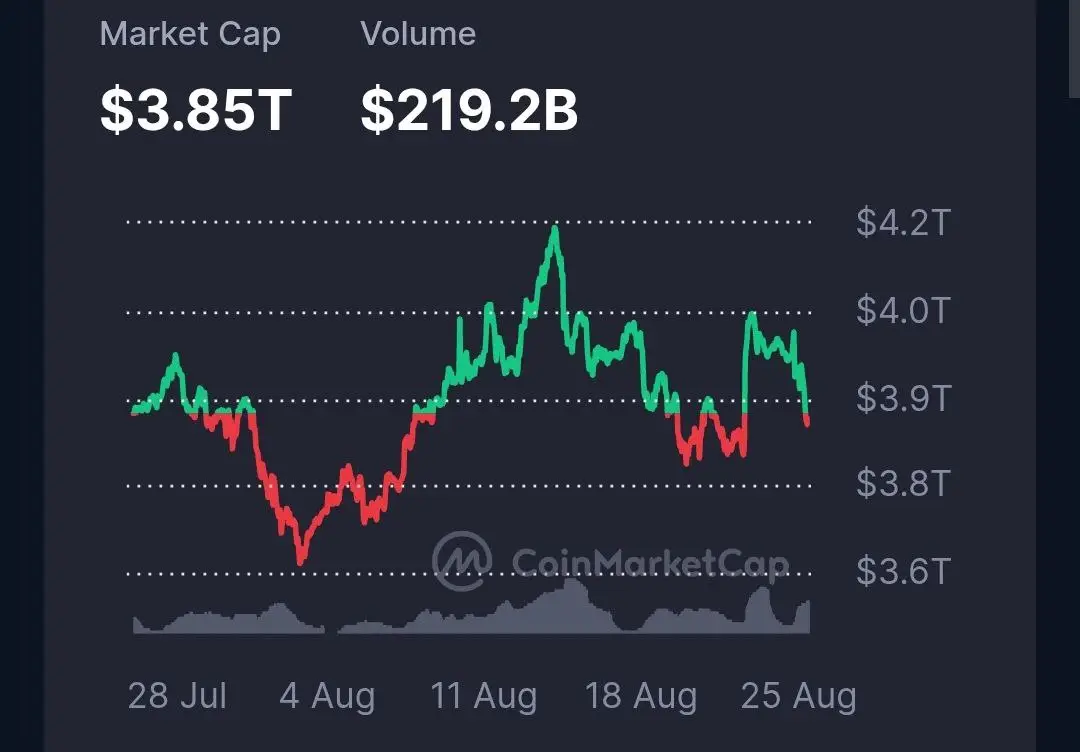
The global cryptocurrency market has recently experienced a notable decline, with the market cap decreasing by 2.95%, currently standing at approximately $3.85 trillion. This downturn can be attributed to various factors that have influenced trader behavior and overall market sentiment.
One significant element contributing to this decrease is Bitcoin’s recent performance. The leading cryptocurrency has found itself consolidating below recent highs. This stagnation often triggers a cautious approach among traders, as prolonged periods of low volatility can lead to uncertainty regarding future price movements. Furthermore, as Bitcoin plays a pivotal role in setting the market’s tone, stagnation in its price may prompt positive sentiment shifts, resulting in decreased confidence across the broader crypto space.
In addition to Bitcoin’s challenges, profit-taking behavior among altcoin investors has further amplified the decline. Many traders who had previously capitalized on substantial gains sought to realize their profits, resulting in increased selling pressure. This trend has particularly affected smaller cryptocurrencies, which are often more volatile and susceptible to rapid price changes. The interaction between profit-taking and market sentiment can create a feedback loop that exacerbates price decline as investors rush to exit their positions.
Finally, broader macroeconomic uncertainties have added another layer of complexity to the situation. Economic factors such as interest rate fluctuations, inflation concerns, and geopolitical tensions have prompted a more cautious approach among investors. These dynamics inherently affect risk appetite and may lead to diminished enthusiasm for more volatile asset classes, including cryptocurrencies. Such apprehensions are crucial in understanding the implications of the recent market decline on both short-term price movements and longer-term market health.
Why the $4 Trillion Level Matters
The $4 trillion market cap represents a significant psychological barrier in the global cryptocurrency market. Major milestone levels in financial markets are often focal points for investor behavior, and the $4 trillion mark is no exception. Throughout the evolution of cryptocurrencies, similar thresholds have acted as both resistance and support, heavily influencing market sentiment and trading patterns. For instance, Bitcoin’s historical milestones have demonstrated that when a particular price point is approached, it often attracts a swell of buying or selling pressure, based on collective investor psychology.
The importance of the $4 trillion level is amplified by its potential to impact confidence among both institutional and retail investors. When market participants perceive a breach of this level, it often serves as a signal that the market is in a bullish phase, catalyzing further investments and inflows into cryptocurrencies. Conversely, failure to maintain this threshold might result in increased market volatility, as traders reassess their positions and strategies. The sentiment around this psychological point often aligns with broader economic factors, impacting decisions made by investors.
<pmoreover, $4="" acceptance="" advancements,="" affect="" and="" approaches="" around="" as="" assets,="" cap="" centered="" commit="" compelling="" could="" critical="" cryptocurrencies.="" cryptocurrencies.
Ultimately, the $4 trillion barrier serves not only as a pivotal point for market dynamics but also as an indicator of the collective mindset of investors. Understanding the psychological implications tied to this level can help market participants navigate the complexities of trading and investment in the evolving landscape of cryptocurrency.
Key Market Drivers Behind the Decline
The recent decline in the global crypto market cap, which has dropped by 2.95%, can be attributed to several crucial factors. A primary driving force behind this pullback is the recent performance of Bitcoin. As the leading cryptocurrency, Bitcoin’s price significantly influences the overall market sentiment. Following a vigorous rally, Bitcoin experienced some volatility, leading to a correction that affected other cryptocurrencies. Traders often react to movements in Bitcoin’s value, and this behavior can trigger a broader market pullback.
In addition to Bitcoin’s performance, profit-taking behaviors among investors have played a significant role. After experiencing substantial gains, many traders decided to liquidate positions to secure profits. This common practice occurs during periods of uncertainty, wherein individuals reassess their investment strategies. Such selling pressure can lead to price declines, reinforcing the downward trend in market cap. It is essential to note that profit-taking does not inherently indicate market weakness; rather, it can signify a natural cycle within financial markets.
Furthermore, the impact of global macroeconomic conditions cannot be overlooked. Developments such as inflation rates, central bank policies, and geopolitical tensions can create uncertainties affecting investor confidence across all asset classes, including cryptocurrencies. However, despite the downturn, it is important to observe sustained high trading volumes. This suggests that while the market may be undergoing a consolidation phase, it does not signify a complete downturn. A healthy market is characterized by periods of rebalancing, providing opportunities for investments to consolidate and strengthen moving forward.
Outlook: Can Crypto Break $4 Trillion Soon?
The cryptocurrency market, despite a recent drop of 2.95% in its overall market cap, remains fixated on the psychological milestone of $4 trillion. This threshold not only signifies a quantitative metric but also reflects the growing investor sentiment and confidence in the crypto space. As the market continues to evolve, several key indicators may shed light on the potential for breaking this crucial cap.
One of the primary factors to consider is the dominance of Bitcoin, which has historically led the market’s movements. Currently, Bitcoin’s market dominance hovers around 40-45%. Analysts often suggest that for a successful push towards the $4 trillion mark, Bitcoin needs to maintain or even increase its dominance. When Bitcoin thrives, its performance tends to positively influence altcoins, fueling an overall bullish trend across the market.
Ethereum’s role is also significant in this context. Its ongoing developments in technology and scalability, particularly with Ethereum 2.0, have solidified its position as a strong contender in the crypto market. As institutional investors increasingly recognize Ethereum’s potential, its resilience may play a pivotal role in fortifying market levels and contributing to the approach towards the $4 trillion milestone.
Furthermore, the trend of institutional adoption has never been more pronounced. With major financial institutions and corporations committing to cryptocurrency investments, there is a palpable shift in perception. As crypto assets integrate into traditional financial systems, investor sentiment is expected to bolster, enhancing the prospects of reaching the psychological barrier.
Expert predictions vary; some analysts foresee a near-term breakout based on current bullish momentum, while others advocate for a more cautious approach, emphasizing the need for sustained trading volumes and regulatory clarity. Overall, the possibility of surpassing the $4 trillion mark remains a focal point for many in the crypto community, representing both a challenge and an opportunity in the ongoing bull market.