
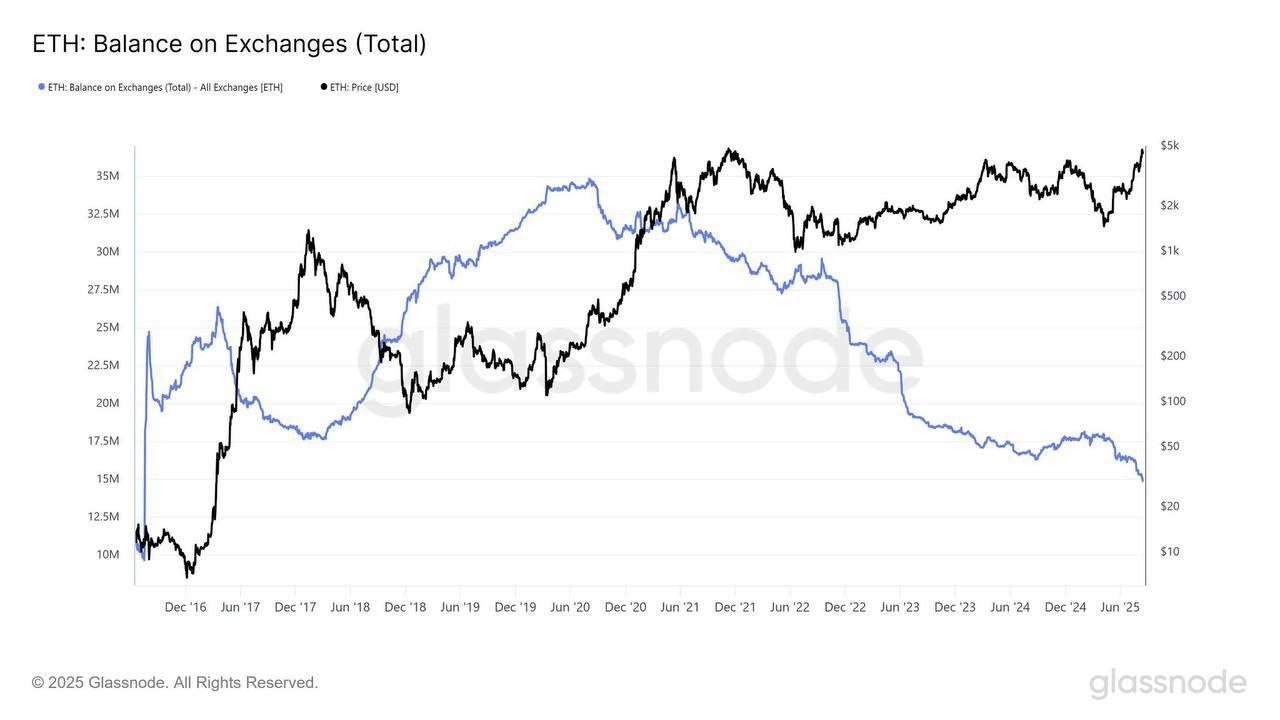
The Declining Ethereum Reserves on Centralized Exchanges
Recent reports from blockchain intelligence firm Glassnode highlight a significant decline in the reserves of Ethereum (ETH) held on centralized exchanges, reaching levels not observed since 2016. This trend reflects a dramatic shift in investor behavior, as participation in centralized platforms becomes less appealing for many Ethereum holders. Various analytics sources provide slightly differing figures regarding the total Ethereum supply on exchanges, yet they converge on the understanding that fewer ETH are available for trading on these platforms.
The reduction in Ethereum reserves can be attributed to multiple factors, including an overall increasing preference for self-custody solutions and decentralized finance (DeFi) alternatives among users. As more investors opt to store their assets in personal wallets or engage directly in DeFi protocols, the demand for centralized exchange services diminishes. This behavior not only impacts the liquidity on these platforms but also raises questions about the future role of centralized exchanges in the trading ecosystem.
The implications of dwindling Ethereum reserves on centralized exchanges are profound. With fewer ETH available for immediate trading, these platforms may experience reduced liquidity, leading to wider bid-ask spreads and increased volatility. Such developments can affect the market dynamics, as traders may find it increasingly challenging to execute large orders without causing significant price fluctuations. Additionally, a lower supply of ETH on exchanges might point to a growing long-term bullish sentiment among investors, as many appear unwilling to sell their holdings in anticipation of potential price increases.
Overall, the decline in Ethereum reserves on centralized exchanges signals a notable transformation in market sentiment and investor strategies. Understanding this shift is crucial for stakeholders, as it can provide insights into the future health of Ethereum as an asset and the broader implications for market stability. The evolution of investor behavior surrounding Ethereum warrants careful observation as its effects unfold in the coming months.
The Importance of Reduced Liquidity
The recent decline in Ethereum (ETH) reserves on centralized exchanges has raised significant concerns regarding market liquidity. Liquidity refers to the ease with which an asset can be bought or sold without causing a drastic change in its price. A reduction in ETH available on exchanges indicates that fewer tokens are available for transactions, potentially leading to decreased liquidity. This situation can create challenges for traders, as it may lead to increased slippage when executing large orders, making it more difficult to achieve optimal trade prices.
Moreover, with fewer tokens available on centralized platforms, the market may experience heightened price volatility. This volatility arises from the basic economic principle of supply and demand; when the supply of an asset diminishes while demand remains constant or increases, prices are likely to fluctuate more significantly. Consequently, investors may witness sharper price movements during trading sessions, complicating decision-making processes and increasing the risk of loss in value when the market moves unfavorably.
Historically, reductions in exchange reserves have been associated with speculative buying and bullish market trends. For instance, in previous cycles where diminished liquidity was observed, ETH experienced notable price rallies following periods of accumulation. This correlation suggests that a similar outcome could occur in the current market scenario, where reducing liquid supply might eventually lead to upward price pressure, particularly if demand continues to grow among investors. Therefore, examining the implications of reduced ETH availability offers insights into possible future market behaviors and price dynamics.
In conclusion, the reduction in Ethereum reserves on centralized exchanges signifies a fundamental shift in the market landscape. This phenomenon not only poses challenges in terms of liquidity but also holds the potential to trigger significant price movements, echoing historical trends that indicate stronger market conditions ahead.
Long-Term Holding Trends and Institutional Involvement
In recent months, the Ethereum market has observed a significant shift towards long-term holding strategies, driven largely by institutional involvement and the activities of prominent whale wallets. This transition indicates a growing confidence in the future value and utility of Ether (ETH), highlighting the changing dynamics within the cryptocurrency landscape.
Data analysis has revealed an unprecedented accumulation of ETH by large holders since early July 2023. This trend is characterized by a marked spike in the number of wallets holding substantial amounts of Ether. Many of these whale wallets are increasingly pulling their ETH off centralized exchanges and transitioning these assets into cold storage or using them in staking protocols. Such actions are indicative of a long-term investment strategy, reflecting a belief in the asset’s ability to appreciate over time. This withdrawal from exchanges contributes to the tightening of supply, fostering a situation that could support price stability and potential upward movement in the future.
Institutional players, including investment firms and asset managers, have also shown keen interest in Ethereum as they recognize its potential beyond speculative trading. Their active participation reinforces the market’s legitimacy and signals increased confidence among long-term investors. Furthermore, various institutions are integrating Ethereum into their portfolios, seeing it as a viable alternative asset that similarly offers diversification and potential growth prospects. This influx of interest from institutional investors is crucial, as it often provides the market with needed liquidity and stability, fostering broader acceptance of Ether as a valuable asset in the financial ecosystem.
Together, these trends signify a paradigm shift in how Ethereum is perceived by both retail and institutional investors, focusing on fundamental value rather than short-term price fluctuations. As confidence among long-term holders and institutions continues to build, the Ethereum market may be poised for a more robust and sustained development phase moving forward.
Implications for Ethereum’s Market and Future Outlook
The recent decline in Ethereum’s reserves on centralized exchanges presents significant implications for the cryptocurrency’s market dynamics and future trajectory. A notable reduction in immediate selling pressure can lead to a more favorable environment for price appreciation. With fewer ETH tokens available on exchanges, the potential for rapid price fluctuations decreases, allowing traders and investors to adopt a more measured and strategic approach.
This shift signifies a maturation of the Ethereum ecosystem. As the market evolves, many holders are transitioning from short-term speculation to a focus on long-term investments. The emphasis on accumulating and holding ETH rather than actively trading may foster a more stable market environment. Such behavior can be attributed to a growing recognition of Ethereum’s utility and its foundational role in various decentralized applications.
Additionally, the diminishing availability of Ethereum on centralized exchanges points to a potential uptick in new inflows. As institutional and retail investors become more cautious of market conditions, they may consider accumulating ETH as a hedge against inflation and market volatility. This influx of new investments could catalyze upward price momentum, further reinforcing the idea of Ethereum as a viable investment vehicle.
Moreover, the current market environment reflects a broader shift in the cryptocurrency landscape, where holders are increasingly adopting a strategy centered around the long-term value proposition of their assets. This strategic investment behavior is likely to contribute to the overall stabilization of Ethereum’s price, fostering a sustainable growth trajectory going forward.
In conclusion, the implications of Ethereum’s low exchange reserves are profound and multifaceted. The combination of reduced selling pressure and potential new inflows may yield significant upward movement in ETH’s price. Coupled with the maturation of the Ethereum ecosystem, the market appears poised for a transformative phase that could redefine investment strategies within the space.