
The Sortino Ratio: Understanding Risk-Adjusted Performance
The Sortino Ratio is a significant metric that helps investors evaluate the performance of their investments while considering the associated risks, particularly focusing on downside volatility. Unlike the widely known Sharpe Ratio, which accounts for total volatility regardless of the direction—positive or negative—the Sortino Ratio hones in on negative price movements. This distinction allows it to provide a clearer picture of an investment’s performance in unfavorable conditions.
In the context of volatile assets such as cryptocurrencies, particularly Bitcoin, the Sortino Ratio is especially pertinent. By concentrating on downside risk, this ratio enables investors to gauge potential losses without penalizing assets for positive price fluctuations. For instance, Bitcoin has experienced significant volatility, leading to both sharp increases in value and substantial declines. Therefore, relying on metrics that include overall volatility may misrepresent its risk-adjusted performance. The Sortino Ratio mitigates this by assessing how well Bitcoin generates returns relative to the risks of harmful declines, making it a valuable tool for investors who prioritize risk management.
Gold, a traditional safe-haven asset, also benefits from analysis using the Sortino Ratio. As investors seek to balance their portfolios between stable assets like gold and more volatile assets like Bitcoin, understanding the risk-adjusted performance of these investments can guide strategic allocation. By emphasizing downside risk, the Sortino Ratio offers a nuanced perspective that fosters a more informed decision-making process.
This metric proves crucial in the current economic landscape where investors increasingly favor assets like Bitcoin and gold. By focusing solely on negative outcomes, the Sortino Ratio empowers investors to make sound investment decisions that align with their risk tolerance and financial goals, ultimately seeking to enhance overall portfolio performance.
Bitcoin and Gold’s Stellar Performance in July 2025
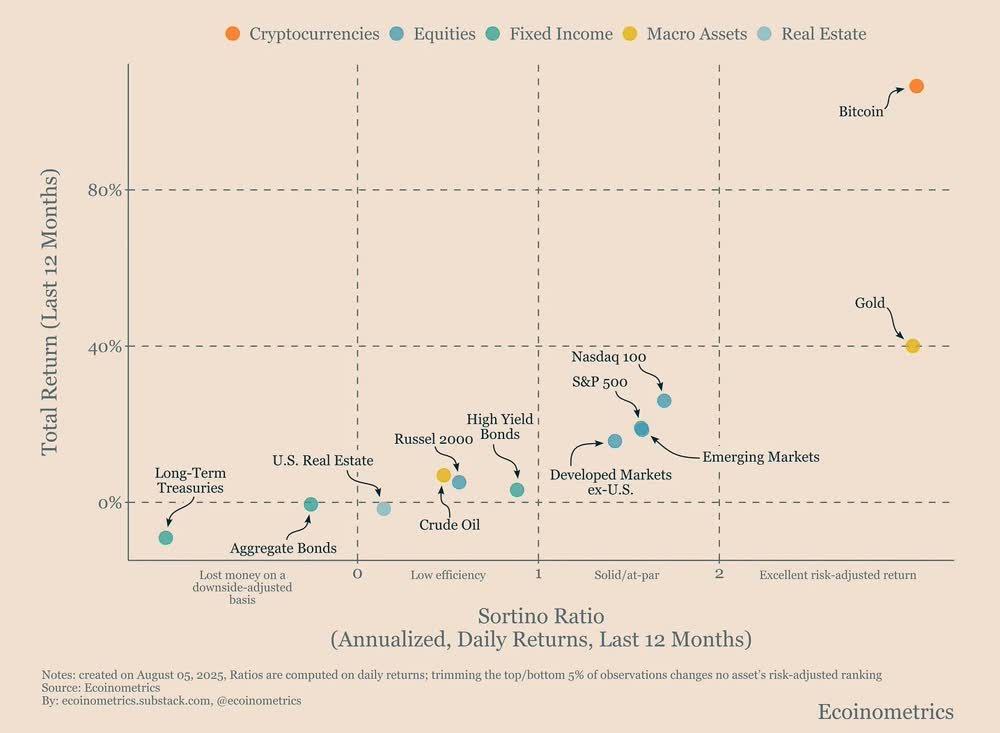
In July 2025, both Bitcoin and gold demonstrated remarkable resilience and performance, emerging as the leading assets in the realm of risk-adjusted returns. According to data compiled by Ecoinometrics, these two investment vehicles exhibited patterns that not only highlighted their growth but also their strategic positions in the market. Bitcoin, in particular, recorded an impressive return of 80% over the past year, a significant milestone that underscores its escalating reputation as a store of value.
The performance metrics of Bitcoin during this period have drawn considerable attention from institutional and retail investors alike. When compared to traditional asset classes, Bitcoin’s annualized return was nearly double that of equities and substantially better than bonds. Such a performance can typically be assessed using the Sortino Ratio, which evaluates an investment’s return relative to its downside risk. Bitcoin’s impressive Sortino Ratio during July 2025 indicates that its substantial returns were accompanied by relatively low volatility, making it a formidable contender for investors seeking risk-adjusted returns.
Gold, historically regarded as a safe-haven asset, also showed commendable performance in July 2025. While it did not match Bitcoin’s exceptional return percentage, gold’s stability and slower price movements have maintained its status as a reliable investment during periods of economic uncertainty. The interplay between Bitcoin and gold as alternative investments has been a focal point of discussion, particularly as Bitcoin continues to establish itself as a digital counterpart to gold.
This juxtaposition in performance not only showcases their individual strengths but also reflects a broader market trend where both assets are gaining traction among investors looking for robust long-term returns. The insights derived from this month’s analysis highlight the potential for Bitcoin and gold to coexist in diversified portfolios aimed at maximizing risk-adjusted returns.
The Implications of Bitcoin and Gold’s Risk-Adjusted Dominance
The striking performance of Bitcoin and gold in the financial markets has significant implications for investors looking to enhance their portfolios. To grasp the full impact, it is essential to understand the concept of risk-adjusted returns, which evaluates the potential return of an asset in relation to the risk taken. Investors are increasingly attracted to Bitcoin, characterized by its remarkable return potential, particularly in recent years. However, the metric of risk-adjusted performance requires careful consideration, as high returns can sometimes be accompanied by increased volatility. Thus, it is critical to assess whether such returns are sustainable and prudent within an investment framework.
Gold has traditionally been viewed as a “safe haven” asset that offers stability during market fluctuations. Its historical role in preserving wealth and mitigating risk adds a protective element to investment portfolios. As Bitcoin continues to emerge as a viable alternative asset, its potential to deliver high returns, combined with its characteristic volatility, makes it crucial for investors to adopt a strategic approach. By incorporating both Bitcoin and gold into their portfolios, investors may successfully balance the twin aims of maximizing returns while managing risk exposure.
The dual strengths of Bitcoin and gold serve as a powerful combination for long-term investment strategies. Bitcoin’s capacity to yield substantial gains can complement gold’s defensive qualities, allowing investors to navigate diverse market conditions effectively. In this context, the implications of their risk-adjusted dominance underscore the importance of a diversified portfolio that recognizes the unique contributions both assets can provide. Such strategic integration not only enhances the potential for higher returns but also ensures that lower drawdowns can be achieved, which is essential for sustained investment success.
Key Takeaways for Investors in a Diversified Portfolio
In July 2025, Bitcoin and gold demonstrated their remarkable capacity to generate attractive risk-adjusted returns, offering valuable insights for investors looking to optimize their portfolios. These two distinct assets, while fundamentally different in nature, have emerged as crucial components in achieving a balanced investment strategy that can withstand market fluctuations. Investors should recognize the potential benefits of integrating both digital and traditional assets to foster resilience against economic uncertainty.
Bitcoin, as a digital currency, has gained substantial traction among institutional and retail investors alike. Its decentralized nature and finite supply offer a hedge against inflation, positioning it as an alternative store of value comparable to gold. In recent months, the cryptocurrency market has shown a notable ability to absorb shocks, displaying impressive price movements that often reflect broader macroeconomic trends. Conversely, gold has maintained its status as a safe haven, providing stability during periods of volatility. The asset’s historical performance highlights its role as a protective measure in times of financial distress.
The new narrative surrounding effective diversification emphasizes not merely a mixture of asset types but a strategic selection that optimizes downside-adjusted returns. Investors are encouraged to assess their risk tolerance and investment objectives, rather than adhering to the traditional norms of asset allocation. By thoughtfully incorporating Bitcoin alongside gold, investors can capitalize on the appreciation potential of both assets while mitigating risks associated with market downturns.
In concluding, the standout performance of Bitcoin and gold in July 2025 underscores the significance of adopting a forward-thinking approach to portfolio diversification. By strategically positioning these assets within a diversified portfolio, investors can enhance their chances of achieving stable yet high gains, ultimately leading to a more resilient financial future.